

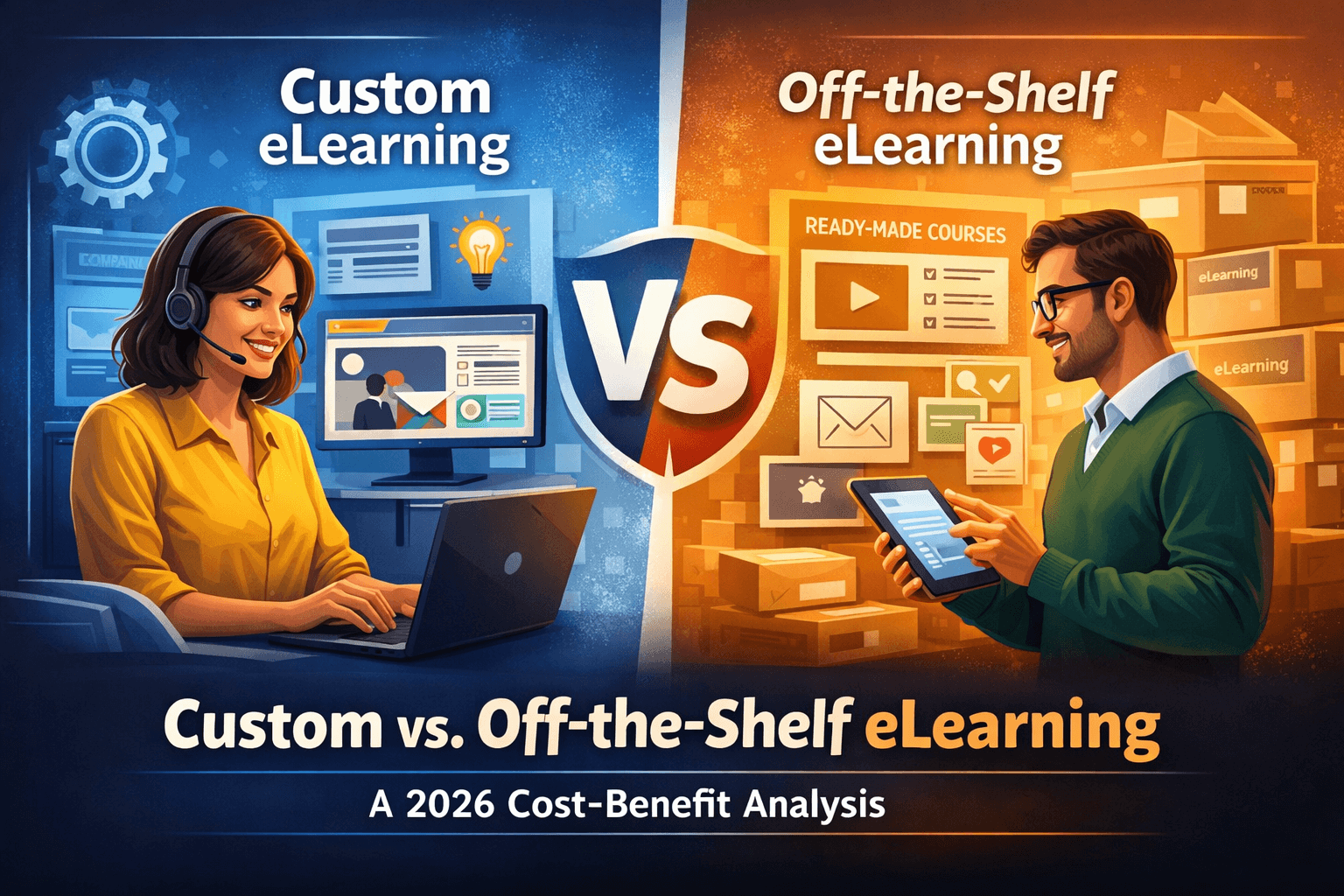
Custom vs. Off-the-Shelf eLearning: A 2026 Cost-Benefit Analysis
Introduction: Why This Decision Matters More in 2026
In 2026, corporate learning is no longer about just delivering content. It’s about speed, compliance, performance, and measurable business impact. With AI-driven workflows, stricter regulations, distributed teams, and rising training costs, choosing custom eLearning vs off-the-shelf eLearning has become a strategic business decision not a tactical one.
Many organisations still ask:
“Is custom eLearning too expensive?”
“Is off-the-shelf training good enough?”
“Which option actually delivers better ROI in the long run?”
This blog answers those questions with a clear, practical cost-benefit analysis for 2026, based on real corporate learning scenarios not theory.
What Is Off-the-Shelf eLearning?
Off-the-shelf eLearning refers to ready-made courses that are pre-designed and sold to multiple organisations.
Common Examples
Compliance courses (POSH, GDPR, Cybersecurity)
Generic soft skills (communication, leadership basics)
Standard safety or induction modules
Typical Characteristics
Fixed content and structure
Limited or no customisation
Faster deployment
Lower upfront cost
Off-the-shelf courses work best when the requirement is generic, urgent, and standardised.
What Is Custom eLearning?
Custom eLearning is designed specifically for your organisation, your processes, your learners, and your performance goals.
Typical Characteristics
Built using your SOPs, products, tools, and scenarios
Aligned with business KPIs
Highly interactive and role-specific
Scalable and updatable over time
Custom eLearning works best when training is expected to change behaviour, reduce errors, or improve performance.
2026 Cost Comparison: Beyond Just Course Price
In 2026, organisations are looking beyond the visible price tag and evaluating the total cost of learning ownership. This includes development, delivery, updates, learner impact, and downstream business outcomes.
1. Initial Development Cost (What You Pay Upfront)
| Aspect | Off-the-Shelf | Custom eLearning |
|---|---|---|
| Upfront Cost | Low | Medium to High |
| Time to Launch | Immediate | 4–10 weeks |
| Content Ownership | No | Yes |
Off-the-shelf courses appear cost-effective because you pay a subscription or per-user fee and can launch immediately. Custom eLearning requires a higher upfront investment because it involves instructional design, content mapping, interactivity, and validation.
However, upfront cost alone does not reflect value. It only reflects speed.
2. Long-Term Cost Impact (What You Keep Paying For)
With off-the-shelf eLearning, costs continue year after year:
Annual licence renewals
Cost increases as learner numbers grow
Re-purchasing content for new hires
With custom eLearning:
Development is usually a one-time investment
Content can be reused across batches and years
Updates are incremental, not a full rebuild
Over a 3–5 year period, many organisations discover that custom eLearning actually costs less per learner than off-the-shelf solutions.
3. Cost of Ineffective Learning (The Hidden Drain)
One cost that is rarely calculated is the cost of learning that doesn’t stick.
If employees forget procedures, make avoidable mistakes, or require repeated retraining, the organisation pays in rework, quality failures, audit observations, and managerial time.**.
2. Hidden & Long-Term Costs (Often Ignored)
Off-the-Shelf Hidden Costs
Annual or per-user licensing fees
Re-buying courses for new cohorts
Low relevance leading to poor engagement
Additional classroom or retraining costs due to low retention
Custom eLearning Hidden Benefits
One-time development with reuse
Lower retraining costs
Faster onboarding
Fewer errors and compliance issues
👉 In 2026, organisations are realising that cheap training that doesn’t work is actually expensive.
ROI Comparison: What Do You Really Get?
Return on Investment in learning is no longer measured by completion rates alone. In 2026, ROI is measured by performance improvement and risk reduction.
Off-the-Shelf ROI: Completion-Focused
Off-the-shelf training typically delivers high completion numbers and basic awareness, but limited skill transfer. Because content is generic, learners may understand what they should do, but not how to do it in their specific role.
ROI here is limited to compliance proof rather than operational improvement.
Custom eLearning ROI: Performance-Focused
Custom eLearning is designed with outcomes in mind. Each module is aligned to a specific behaviour or business goal.
Measurable returns often include faster onboarding, reduced errors, improved audit readiness, and better recall scores. Instead of asking whether employees finished the course, organisations can track whether performance improved after training.**.
Scalability & Future Readiness (A 2026 Reality Check)
Off-the-Shelf Scalability
Scales in numbers, not relevance
Same content for all roles
Difficult to adapt to internal changes
Custom eLearning Scalability
Easy to update modules
Role-based learning paths
Integrates well with LXPs and LMS platforms
AI-ready (adaptive learning, analytics)
If your organisation expects growth, role diversification, or regulatory change, custom eLearning offers better future-proofing.
Learner Engagement: The Deal Breaker
In 2026, employees expect learning experiences similar to the apps they use daily.
Off-the-Shelf Experience
Most off-the-shelf courses are designed to work for everyone, which usually means they are deeply relevant to no one.
Learners typically go through slide-based content with generic examples that don’t reflect their real workplace challenges. Because scenarios are not role-specific, learners often struggle to connect the training with what they actually do on the job.
This leads to:
Low attention spans during the course
Minimal emotional or practical connection
Poor knowledge retention after completion
As a result, employees may complete the course, but struggle to apply the learning when real situations arise — especially under pressure.
Custom eLearning Experience
Custom eLearning is designed around how employees actually work. Instead of generic slides, learners engage with realistic scenarios, decision-based activities, and simulations that mirror their daily tasks.
For example, a learner may be asked to choose the right action in a simulated workplace situation, receive immediate feedback, and understand the consequences of incorrect decisions.
This approach:
Keeps learners actively involved
Improves recall through practice-based learning
Builds confidence before real-world application
Higher engagement directly improves knowledge retention and on-the-job performance.
When Off-the-Shelf eLearning Makes Sense
Off-the-shelf eLearning is a practical choice when the training requirement is simple, standardised, and low-risk.
It works well when:
The topic is common across industries and roles
Speed of deployment is more important than deep learning
The goal is awareness rather than skill mastery
In such cases, investing time and budget into custom development may not be necessary.
Example:
An annual POSH or information security refresher for office staff where employees only need to understand basic dos and don’ts. The risk of incorrect application is relatively low, and standard content is sufficient.
When Custom eLearning Is the Smarter Choice
Custom eLearning becomes the better option when training has a direct impact on business outcomes, safety, quality, or revenue.
It is especially valuable when:
Employees must follow detailed SOPs
Errors can lead to financial loss or compliance issues
Performance consistency is critical
Custom content ensures that learners practice exactly what is expected from them — not a generic version of it.
Example:
GMP training for pharma operators, where even a small deviation can result in batch rejection or audit observations. Custom eLearning allows learners to practice procedures in a safe, simulated environment before performing them on the shop floor.
A Smarter 2026 Approach: Hybrid Learning Strategy
In 2026, many organisations are moving away from an “either-or” mindset and adopting a hybrid learning strategy.
Instead of choosing only one approach, they combine both based on business need:
Use off-the-shelf courses for generic compliance and awareness
Use custom eLearning for role-critical, high-impact training
This approach helps organisations:
Control costs
Maintain speed of rollout
Maximise learning impact where it matters most
A hybrid strategy ensures training budgets are spent strategically, not uniformly delivering better overall ROI.
If you’re evaluating your learning strategy for 2026 and want an honest recommendation not a sales pitch, talk to an expert who understands both options and your business context.
The right learning decision today saves cost, risk, and effort tomorrow.